Three interdependent moves needed to transform how private wealth operates during the Great Wealth Transfer
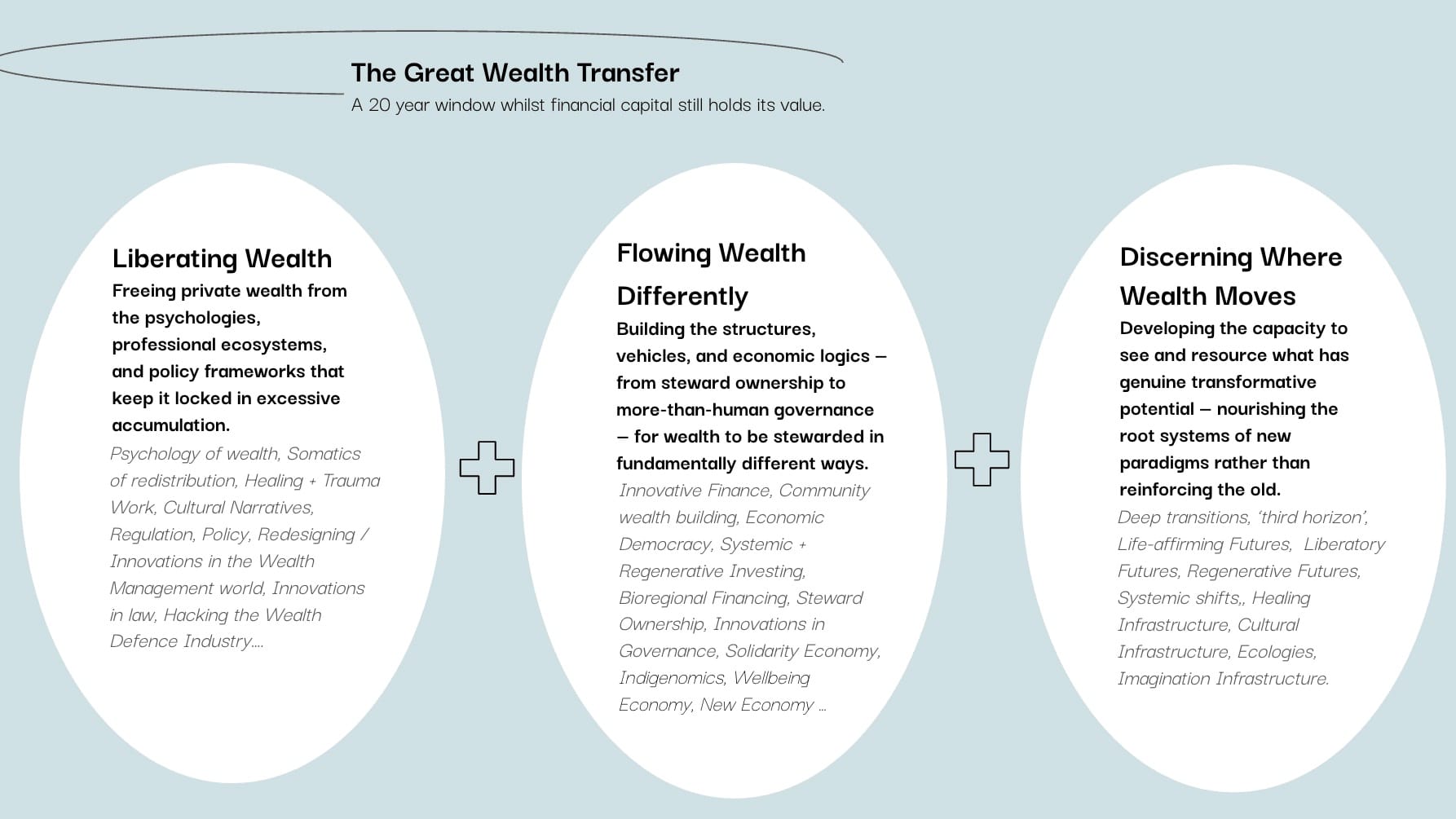
We are living through what many are calling the Great Wealth Transfer — the largest movement of private capital between generations in modern history. Over the next two decades, trillions of dollars will pass from one set of hands to another.
The question is not whether this wealth will move. It will. The real question is what it will do when it does. Will it continue reinforcing the economic systems that concentrated it in the first place? Or could it help build something more stable, more just, and more life-serving?
For nearly a decade, I’ve worked alongside people grappling with this question — inside philanthropic institutions, in systems-change initiatives, and increasingly accompanying wealth holders and working deeper inside the world of private wealth itself. What has become clear to me is this: transforming the role of private wealth requires more than goodwill, and more than new financial products. It requires change at three levels at once — how wealth is released from accumulation, how it is structured and governed as it moves, and how we decide what it should support.
What follows is a framework I've developed for what meaningful transformation requires. These are not steps in a sequence. They are interdependent shifts. Without all three, wealth tends to fall back into familiar patterns.
Liberating Wealth
The first move is about release. An extraordinary proportion of the world's private wealth is currently locked in structures designed to preserve and accumulate it — privately, indefinitely, and at an accelerating rate. It is stuck. Hoarded. Excessively held. Circled by an entire professional ecosystem — wealth managers, trust lawyers, family offices, tax advisors, estate planners — whose economic model depends on keeping it that way. Before wealth can do anything differently, it has to be freed from the architecture of its own preservation. This is harder than it sounds, because the locks are not only structural. They are also psychological, relational, and cultural.
This is harder than it sounds, because the locks are not only structural. They are also psychological, relational, and cultural.
At the most intimate level, there is the interior landscape of wealth holders themselves. What is my wealth for? What is enough? What am I afraid of? These are not peripheral questions. They are the questions that determine whether someone with significant resources can act on what they already know — that the systems which created their position are now sources of systemic risk, that accumulation beyond a certain point becomes a form of harm, that their children might be better served by a functioning society than by a trust fund. The psychological formations shaped by accumulation tend to reproduce accumulation's worldview: scarcity as foundational, control as safety, separation as natural. These are not personal failings. They are predictable outcomes of living inside a particular story about what wealth is and what it's for. But until they shift, even well-intentioned action can reinforce the structures it claims to transform.
Then there is the professional infrastructure. The wealth management industry is not a neutral service sector. It is a wealth protection industry — a vast, sophisticated, and largely invisible ecosystem of advisors, structures, and incentive systems whose core function is to protect private capital from redistribution. Trust structures, offshore arrangements, portfolio complexity, fiduciary interpretation — these are the mechanisms through which wealth is kept in orbit around itself. Transforming this infrastructure means developing alternatives: different kinds of wealth advice, different professional incentives, different legal and financial innovations that make it easier and more attractive to move money toward life. This is what the Wealth Hackers Initiative was built for — a network of deep experts operating from inside financial systems, developing 'hacks' that can rapidly shift how money moves.
And at the widest scale, there is the policy and regulatory landscape — the tax regimes, fiduciary frameworks, and cultural norms that make excessive accumulation rational. The movements working at this level — tax justice campaigns, Patriotic Millionaires, Proud to Pay More, the concept of an extreme wealth line, efforts to shift fiduciary duty from its narrow interpretation — are essential to changing the conditions within which individual and institutional decisions are made. Without structural change at this level, everything else remains exceptional rather than expected.
All the moves in this first pillar share a direction: away from excessive preservation, so that wealth flows.
Flowing Wealth Differently
Once wealth is released from the logic of indefinite private accumulation, it needs somewhere to go — and how it is held and governed as it moves matters as much as where it arrives. This is where the second pillar meets its most formidable obstacle: the economic system itself.
The dominant economic paradigm — extractive capitalism, organised around perpetual growth, financial return maximisation, and the enclosure of shared resources — is not simply the backdrop against which wealth transformation happens. It is the active force that recaptures and domesticates alternatives. Impact investing is perhaps the clearest example: a movement that began as a genuinely radical proposition — that capital could be deployed for social and ecological benefit — has been progressively absorbed into the logic it was supposed to challenge. The insistence on market-rate financial returns, the adoption of conventional risk frameworks, the gravitational pull of fiduciary duty as narrowly interpreted — all of these have tended to tame impact investing into a slightly greener version of business as usual. The structure of the economy doesn't just fail to support alternatives; it actively metabolises them, stripping out whatever is genuinely disruptive and returning the rest to familiar patterns.
This means that building new vehicles and structures for how wealth is held — while essential — is not enough on its own. Donor Advised Funds being a prime example. The structures need an economic logic to inhabit that is fundamentally different from the one that currently dominates. This is the work of the new economy movements: doughnut economics, with its insistence on a safe and just space between social foundations and ecological ceilings; the wellbeing economy, which redefines what an economy is for; solidarity economy, which centres cooperation, mutualism, and democratic governance; bioregional finance, which roots capital in place, ecology, and relationship rather than in abstract markets. These are not academic propositions. They are working attempts to articulate and build the economic paradigm within which different structures for holding wealth would actually make sense — and survive.
Within this shifting landscape, there is already a rich if still marginal ecosystem of structural innovation. Steward ownership models, where companies are held in trust for their mission rather than for shareholder return. Cooperatives and community wealth building structures that distribute ownership and governance across the people a venture actually serves. Regenerative and systemic investment approaches that understand returns as ecological and social, not only financial. Seed commons and other models that remove essential resources from the logic of enclosure. New financial instruments designed for transition — patient, flexible, comfortable with emergence. Bioregional financing that makes geography and ecology — not abstract markets — the unit of investment. Perpetual trusts governed by nature, more-than-human governance structures, and commons-based arrangements that extend the question of stewardship beyond the human altogether.
These innovations are not fringe experiments. They are the infrastructure of a different economy, being built in real time. But they face a double challenge: they remain dramatically under-resourced relative to the scale of the wealth transfer now underway, and they are operating inside an economic system that is structurally hostile to their survival. There is a vast asymmetry: The infrastructure for preserving private wealth is centuries deep, sophisticated and well-resourced. The infrastructure for moving wealth out of accumulation and into life-serving structures is not.
There is a vast asymmetry: The infrastructure for preserving private wealth is centuries deep, sophisticated and well-resourced. The infrastructure for moving wealth out of accumulation and into life-serving structures is not.
Discerning Where Wealth Moves
The third move is the hardest and, I believe, the most consequential. It concerns discernment — the capacity to recognise what has genuine transformative potential, to resource it, and to protect it as it grows.
This matters because the gravitational pull of the present is enormous. When wealth does flow — through philanthropy, through impact investment, through the decisions of inheritors and trustees — it overwhelmingly flows toward the familiar: the status quo, the reform agenda, the incremental improvement, the plaster over the wound. Discerning something with genuinely transformative potential, and not getting pulled back into current logics, is one of the hardest things there is. Foundations that have been at the forefront of supporting systems transformation are experiencing great pressure to refocus on more locally tangible impacts — a kind of system snapback, an order response, that reasserts present-centred priorities whenever emergence gets uncomfortable.
What is needed instead is the capacity to see and nourish the root systems of new paradigms — the new logics, patterns, and ways of organising that are trying to emerge, often quietly, often at the margins, often in forms that don't yet look like what we're used to funding. Some of these are genuinely new. Others are not emerging at all but resurfacing — Indigenous economies, commons governance, relational ways of knowing that predated and were dismantled by the very systems that concentrated wealth.
This requires a different set of capacities than conventional philanthropy or investment develops. It requires imaginative capacity — the ability to recognise propositional futures, wireframe structures built from different foundations, not just critiques of the current one. It requires attunement to systemic risk, to Polyconsequences, to the Metacrisis — a willingness to sit with the scale of what is shifting rather than retreating to manageable interventions. It requires comfort with emergence: the ability to recognise a pattern worth protecting before it has proved itself on anyone's metrics. And it requires the discipline not to pull emerging work back into familiar frames — not to domesticate the genuinely new by demanding it perform in the language of the old.
The interdependence
These three moves are not a sequence — liberate, then hold differently, then discern. They are interdependent. Each enables and requires the others.
Without liberation, there is nothing to steward differently — the wealth stays locked. Without new structures and vehicles, liberated wealth has nowhere to go except back into conventional channels. Without discernment, even wealth held in innovative structures will flow toward the familiar, the incremental, the safe.
And the people who work across these pillars rarely work in only one. The wealth holder doing the inner work of questioning what enough means is the same person who needs access to steward ownership structures and who needs communities that can help them discern where resources should flow. The policy advocate shifting fiduciary duty is creating conditions for new financial instruments which in turn enable investment in emerging paradigms. The practitioner building regenerative investment vehicles needs wealth that has been liberated from preservation and directed with discernment toward what is actually trying to grow.
This is why I think of the Great Wealth Transfer not as a logistical event of trillions changing hands but as a moment of possibility that requires a coordinated transformation across all three dimensions simultaneously.
I have spent significant time in the third pillar — the work of discernment, imagination, resourcing emerging futures and the invisible infrastructures for transition — through my years in philanthropy and systems change practice. Now I am primarily focused on the first: the liberation of wealth from the structures, psychologies, and professional ecosystems that keep it stuck. This is where I believe the greatest leverage currently lies — not because the other pillars are less important, but because without the first move, a critical mass of people with concentrated resources, the others cannot operate at the scale this moment demands.